
AI is breaking our marketing metrics. That might be a good thing

Does it feel as though every marketing conversation is about AI these days? You’re not alone. With the rules changing so quickly, it can be hard to know what to do next.
But take a closer look and the machines may be doing us a favour. For cause-driven organisations finalising their 2027 campaign plans, there’s a useful side effect worth considering: AI is forcing us to rethink not only how we influence audiences, but how we know whether we’ve influenced them at all.
That matters because, over the past 20 years, we’ve become a little too comfortable measuring what is easy to see.
When discovery leaves no click
AI increasingly sits between audiences and the organisations trying to reach them, whether through a conversation with an AI platform or an AI-generated answer at the top of a search page.
The result is the rise of the zero-click internet: people can discover and consume information without ever visiting the website of the organisation that created it.
Similarweb reported in June 2026 that 68% of Google searches ended without a click. Separately, Ahrefs’ analysis of 300,000 keywords, published in February 2026, found that the presence of an AI overview correlated with a 58% lower average click-through rate for the top-ranking page.
For marketers, the challenge is that the information and ideas that create value around your organisation or cause can become separated from their source. Your content may be influencing someone even though your analytics never see them arrive. Within a traditional attribution model, the content doing the influencing can become almost invisible.

Easy to measure doesn’t mean most valuable
The zero-click era exposes a problem that has been bubbling away for years: we’ve become so accustomed to prioritising reassuring digital metrics that we’ve started to confuse measurability with value.
Clicks, website visits, QR-code scans and sign-ups are all useful indicators. But are they really the key indicators of whether a campaign worked, or have we been overvaluing clicks and undervaluing less visible behaviours?
It makes sense that being recognised, remembered and trusted can matter far more than being clicked. The problem is that clicks are easy to count, while memory, trust, conversation and influence are harder to see.
From funnels to ecosystems
As AI makes some audience interactions harder to track, we need to look beyond a neat, linear model of visibility → authority → participation → action. Human behaviour was never really that tidy. Instead, we need to think about an ecosystem of channels, encounters and influences, and ask what effects our content creates across it. I’d suggest five:
- Exposure: Did people encounter us or our ideas?
- Attention: Did they actually notice or consume them?
- Mental availability: Did we make our organisation or cause easier to remember later?
- Social transmission: Did the idea travel between people?
- Behavioural effect: Did anyone do anything differently?
This changes the question we ask when evaluating a campaign. Instead of asking, ‘Which piece of marketing caused this action?’, we need to ask, ‘What evidence do we have that our marketing made this outcome more likely?’
That’s a shift from attribution to contribution: recognising that marketing can help bring about an outcome without being its sole, directly traceable cause.

Better measurement, not less accountability
This isn’t an argument for less accountability. Non-profits still need evidence that campaigns are working, both to justify budgets and to challenge strategies. But evaluation methods need to match the question we’re trying to answer and the scale of the campaign.
That means reconnecting campaign evaluation with actual human beings, not just dashboards, and looking beyond digital metrics. Useful methods include:
- pre- and post-campaign surveys to track awareness, understanding, trust or intent;
- comparison groups, including groups not shown the campaign, to assess the difference it made;
- supporter research over time to see how relationships change;
- social listening and qualitative research to understand how ideas travel;
- behavioural data to identify changes in participation, donations, service use or campaigning.
Not every campaign needs every measure. But every campaign should be clear about what effect it is actually trying to create.

What did our content do for people?
For years, we’ve focused on what audiences did with our content: whether they clicked, shared, visited or signed up. The zero-click era demands a more interesting question: what did our content do for them?
Did it help them understand, remember our cause or find something worth talking about? Did it make them more likely to act, today or six months from now? That is where impact lives.
So, before you finalise your 2027 campaign plans, build a content-effectiveness framework that captures the visible and the less visible effects of your work. These four questions are a useful starting point:
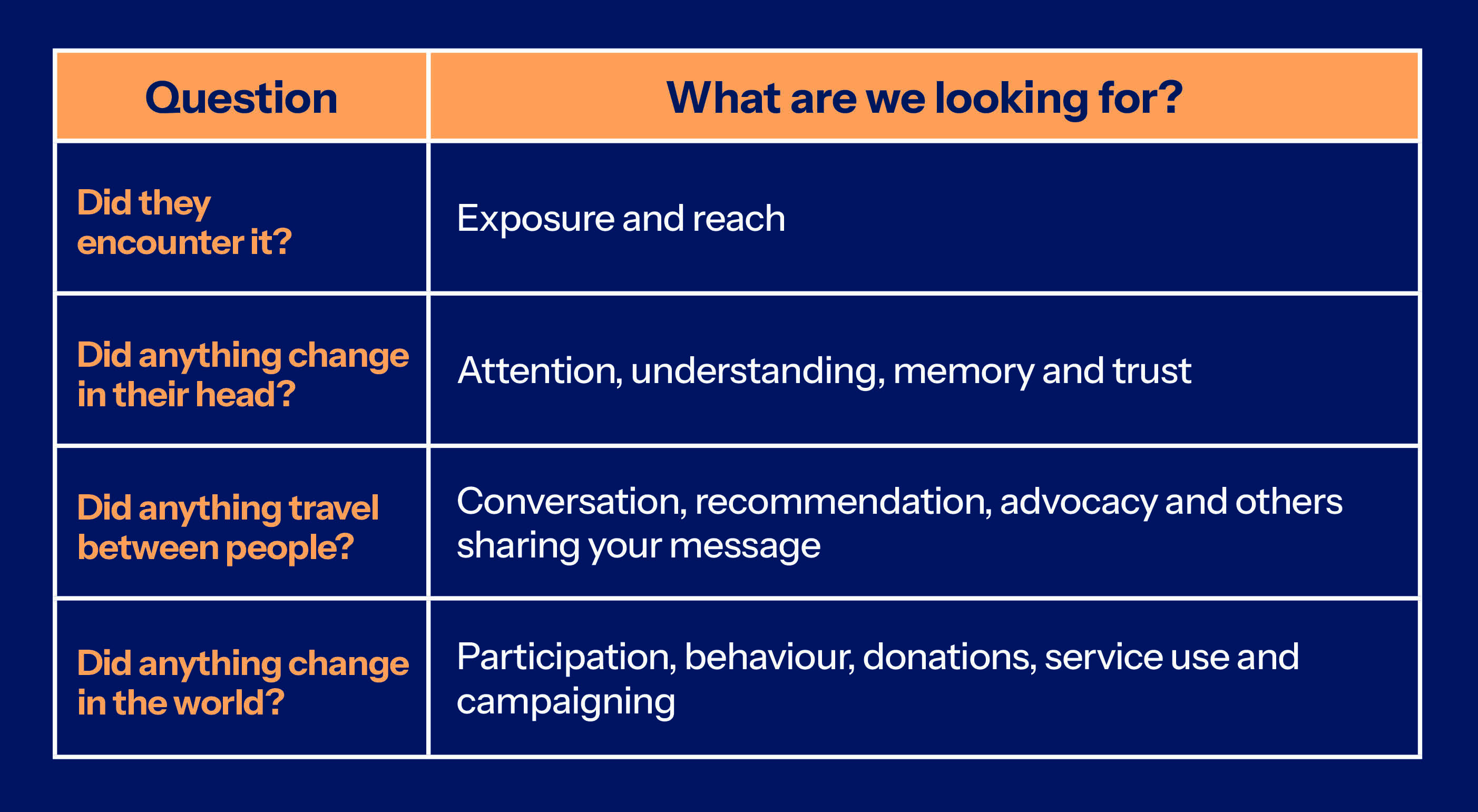
In a world where fewer interactions leave a neat digital footprint, what we can measure most easily and what matters most are not always the same thing. Perhaps AI forcing us to recognise that isn’t such bad news after all.
Sources: Similarweb ahrefs
Images: unsplash.com
More than just a strategic content agency
Content Marketing
We help our clients succeed through brilliantly told stories, the richest products and most effective campaigns.
Content Production
Our studios can produce content for any format, channel or medium. Always delivering the highest quality and biggest impact.
Monetisation
We create new revenue streams and commercial models for our clients rooted in our expertise of specialist content.
Consultancy
We help our clients assess new opportunities and overcome obstacles through a combination of data, insight, strategy and technology.
Advertising
Connect with our audiences that make up over 20% of the UK population in the environments that matter to them.

The exterior of our Bristol HQ